Mastering Throwing Technique
Building a consistent, repeatable stroke from the ground up.

Throwing a dart accurately is fundamentally about eliminating moving parts. The human body is a complex system of hinges and levers; the more joints you involve in the throwing motion, the higher the mathematical probability of an error occurring. A textbook darts throw locks down the shoulder, isolates the elbow, and relies entirely on a smooth, piston-like extension of the forearm.
Stance and Footwork
Accuracy begins at the floor. If your base is unstable, your upper body will sway during the throw, moving your sightline and changing your release angle.
Your dominant foot (the right foot for a right-handed player) should be pressed against the back of the oche. Do not step on or over the line. There are three primary angles for the lead foot:
- Parallel: The foot rests sideways against the oche. This provides maximum stability but requires you to twist your upper torso significantly to face the board.
- Forward-Facing: The toes point directly at the board. This allows the torso to face squarely but offers very poor lateral balance.
- The 45-Degree Angle: The most common stance. The foot is angled, offering a compromise between solid base stability and comfortable torso alignment.
Regardless of foot angle, your weight distribution is critical. Approximately 70% to 80% of your weight should rest on your front foot. You should lean slightly forward over the line, using your back foot strictly as an anchor to prevent leaning so far that you lose balance. Your body must remain absolutely motionless during the throw.
The Grip
There is no universally "correct" grip, but there is a universally correct principle: the grip must be relaxed. Holding the dart too tightly—the "white knuckle" grip—creates tension in the forearm, making a smooth release impossible. The dart should be held firmly enough that it doesn't slip, but lightly enough that you could easily pull it out of your own fingers.
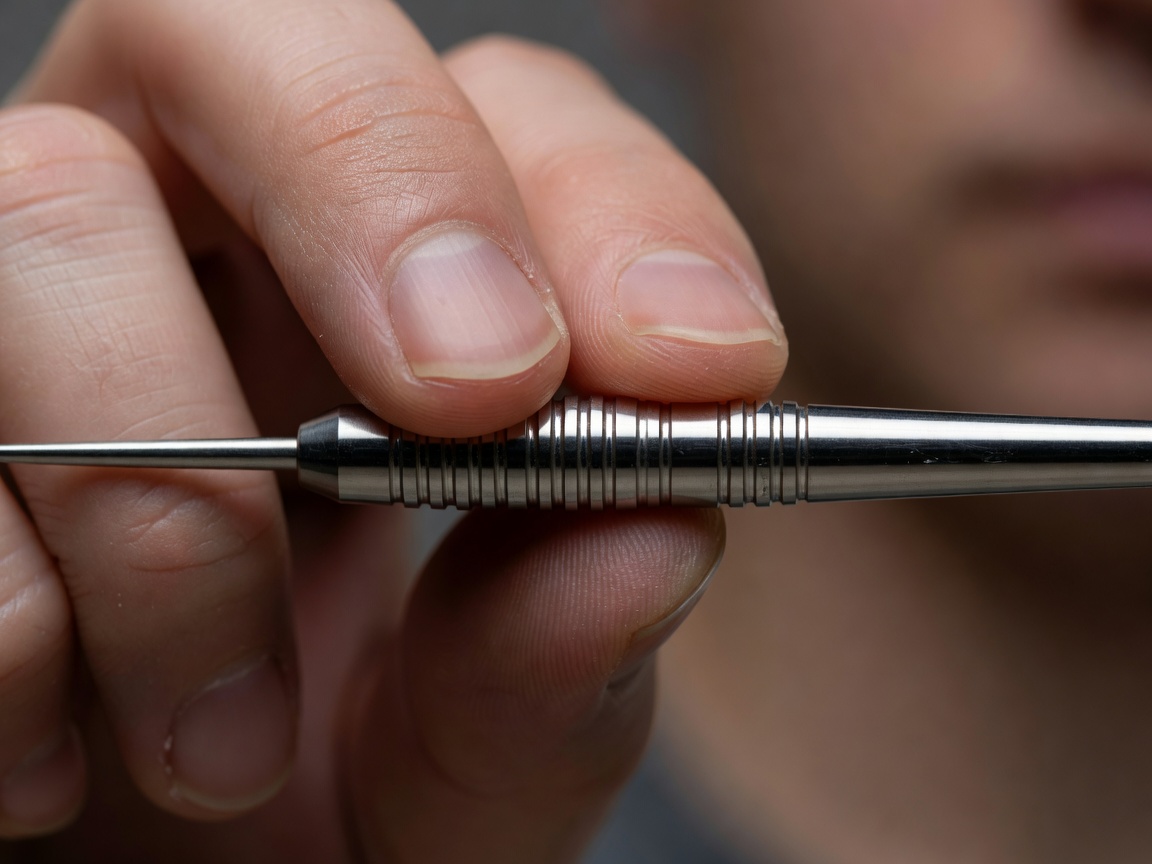
Most players naturally adopt a pencil grip or a three-finger grip (thumb, index, and middle finger). The thumb is the primary anchor, sitting behind the center of gravity of the barrel. The index finger provides the counterbalance, and the middle finger rests slightly further down or near the point to stabilize the dart horizontally. Avoid having too many fingers touching the dart, as each point of contact is a potential snag point during the release.
The Throwing Mechanic
The actual throw consists of four distinct phases: the aim, the draw back, the acceleration, and the follow-through.
1. Aim and Sightline
Bring the dart up to your eye line. Your dominant eye, the dart, and the target should form a straight line. Your upper arm should be roughly parallel to the ground, with your elbow pointing directly at the board.
2. The Draw Back
Slowly pull the dart straight back toward your eye or cheek. The speed of the drawback should be deliberate and controlled. Pulling back too quickly can jerk the shoulder or cause the elbow to drop. The distance you draw back depends on your personal biomechanics, but pulling back further generates more potential energy, meaning you don't have to force the forward stroke.
3. The Acceleration and Release
Without pausing for too long at the back of the stroke, smoothly reverse direction and accelerate the forearm forward. The elbow must remain stationary like a hinge until the very end of the stroke. The release happens naturally as the arm extends. Do not consciously try to "let go" at a specific microsecond; allow the fingers to open as the arm naturally thrusts forward.
4. The Follow-Through
This is where most amateurs fail. After the dart has left your hand, your arm must continue its motion until it is fully extended, pointing directly at the target. Your wrist should snap downward, looking somewhat like a swan's neck. If you recoil your arm immediately after releasing the dart (short-arming), the deceleration will begin before the dart has left your hand, drastically killing momentum and accuracy.
Summary of the Golden Rules
To troubleshoot a failing technique, always check these three elements first: Is my body swaying? Is my elbow dropping during the throw? Am I following through fully? Correcting these three mechanical errors will solve ninety percent of accuracy issues.